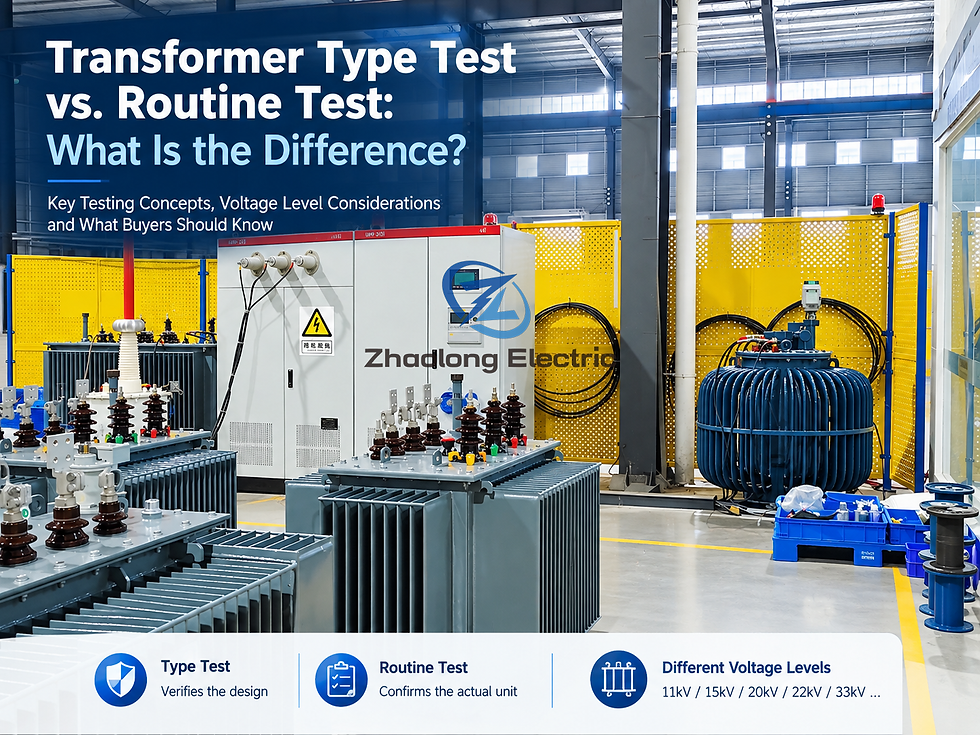
Transformer Type Test vs. Routine Test: What Is the Difference?
Type Test and Routine Test are two important parts of transformer testing, but they serve different purposes.
When purchasing a power or distribution transformer, customers often ask for a Transformer Type Test Report. At the same time, manufacturers provide Routine Test Reports for the actual transformers before shipment.
This can sometimes cause confusion:
-
What is the difference between a Type Test and a Routine Test?
-
Does every transformer need a Type Test?
-
What happens if a customer requires an 11kV, 15kV, or 22kV transformer, but the manufacturer does not have a Type Test Report for exactly that voltage?
-
Can a 10kV Type Test Report be used for an 11kV transformer?
-
Can a 33kV or 35kV Type Test Report represent a 22kV transformer?
These questions are particularly important in international transformer projects, where voltage systems can vary significantly from one country to another.
1. What Is a Transformer Routine Test?
A Routine Test is performed on the individual transformer being manufactured and supplied.
Its main purpose is to verify that the actual transformer has been manufactured according to the specified design and applicable requirements.
Depending on the transformer type, applicable standard, and project specification, routine tests may include:
-
Winding resistance measurement
-
Voltage ratio measurement
-
Phase displacement verification
-
No-load loss and no-load current measurement
-
Short-circuit impedance and load loss measurement
-
Dielectric or insulation-related tests
-
Other tests required by the applicable standard or project specification
One important feature of a routine test report is that it provides actual test results from the transformer being supplied.
For example, the report can show the measured winding resistance, voltage ratio, losses, impedance and other test results of the actual unit.
This makes the Routine Test Report an important part of the factory acceptance and pre-shipment process.
2. What Is a Transformer Type Test?
A Type Test has a different purpose.
Rather than focusing primarily on whether one individual transformer has been manufactured correctly, a Type Test is used to demonstrate the performance of a particular transformer design under specified test conditions.
Depending on the applicable standard and transformer design, type tests may include tests such as:
-
Temperature-rise test
-
Lightning impulse test
-
Short-circuit withstand test
-
Acoustic noise test
-
Other specified type tests
For transformers, dielectric requirements and related tests are closely associated with the insulation system and specified voltage levels. IEC 60076-3, for example, addresses insulation requirements, dielectric tests and external clearances in air for power transformers.
Because type testing can require specialized laboratory facilities, test transformers, preparation and detailed documentation, it can involve considerably more time and cost than routine factory testing.
3. Why Don't Manufacturers Have Type Test Reports for Every Voltage Level?
This is a practical issue that frequently appears in international transformer projects.
Electrical systems are not identical in every country.
For example, manufacturers in China commonly work with voltage levels such as:
10kV and 35kV
However, overseas projects may require:
6kV, 11kV, 15kV, 20kV, 22kV, 33kV, and other voltage levels depending on the local power system.
A manufacturer may have extensive experience producing transformers for these voltage levels without necessarily having a separate Type Test Report for every single one.
One reason is that Type Testing requires significant resources. A manufacturer cannot realistically perform a complete set of tests for every possible voltage and rating simply to maintain a report for every market.
Therefore, even an established transformer manufacturer may have Type Test Reports for some voltage classes but not for every voltage requested by international customers.
This leads to an important distinction:
Not having a Type Test Report for a specific voltage is not necessarily the same as being unable to manufacture a transformer for that voltage.
Manufacturing capability and project-specific documentation requirements are two different questions.
4. What Happens When the Required Transformer Voltage Does Not Match the Type Test Report?
This is where international transformer procurement can become complicated.
For example, a customer may require:
11kV transformer
while the manufacturer has an existing:
10kV Type Test Report
Or a project may require:
22kV transformer
while the manufacturer has Type Test Reports for:
33kV or 35kV transformers.
It is important not to make a simple assumption that:
10kV and 11kV are close enough, so the 10kV Type Test automatically applies.
Likewise, it would not be technically appropriate to assume:
33kV is higher than 22kV, so the 33kV Type Test automatically covers the 22kV transformer.
The relationship between a Type Test and a proposed transformer cannot be determined simply by comparing the numbers on the nameplate.
5. Why Is the Voltage Level Important for Transformer Type Testing?
Transformer insulation and dielectric requirements are related to the specified voltage system and the corresponding insulation levels.
Depending on the design and applicable requirements, technical considerations may include:
-
Highest voltage for equipment
-
Lightning impulse withstand level
-
Power-frequency withstand level
-
Insulation coordination
-
Winding arrangement
-
Insulation structure
-
Internal clearances
-
Rated power
-
Impedance
-
Temperature-rise design
-
Cooling method
-
Other relevant design parameters
IEC 60076-3 specifically addresses insulation requirements and corresponding dielectric tests for transformer windings and terminals.
Therefore, whether an existing Type Test is technically representative of another transformer design requires a proper technical assessment.
It should not be determined simply by saying that one voltage is “close to” another, or that one voltage is higher than another.
6. Can a 10kV Type Test Report Be Used for an 11kV Transformer?
This is a question that can arise frequently in international projects.
The answer should not simply be “yes” or “no” based only on the nominal voltage.
The technical relationship between the tested transformer and the proposed transformer needs to be evaluated based on the applicable standard, project specification and relevant design parameters.
For example, the engineering review may need to consider:
-
Insulation level
-
Dielectric test requirements
-
Winding design
-
Insulation arrangement
-
Clearances
-
Rated capacity
-
Impedance
-
Other relevant design characteristics
More importantly, the final acceptability of a Type Test Report for a specific project depends on the requirements established by the customer, utility, consultant, project specification or other responsible authority.
Therefore, a manufacturer or exporter should not simply tell a customer that:
“Our 10kV Type Test Report is equivalent to an 11kV Type Test Report.”
Such a conclusion requires technical justification and project-specific acceptance.
7. What About 15kV, 20kV or 22kV Transformers?
The same principle applies to other non-standard or market-specific voltage levels.
For example, a customer may require a 22kV transformer, while the manufacturer's available Type Test documentation is based on a 33kV or 35kV transformer.
It would be incorrect to conclude automatically that the higher-voltage test report covers the lower-voltage transformer.
The relationship between the tested design and the proposed design needs to be considered in detail.
This may involve reviewing:
-
Rated voltage
-
Highest voltage for equipment
-
Insulation levels
-
Dielectric test levels
-
Winding construction
-
Insulation system
-
Rated power
-
Impedance
-
Thermal design
-
Other relevant design parameters
For this reason, when an overseas project requires a specific voltage level, the Type Test requirement should ideally be identified before the supplier and transformer design are finalized.
8. Why Can a New Transformer Type Test Take Months?
Another practical issue is the time required to obtain a new Type Test Report.
If a manufacturer does not already have a Type Test Report for the required transformer design, a new test may involve several stages:
Engineering design
↓
Manufacturing of the test transformer
↓
Laboratory testing
↓
Test data collection and analysis
↓
Test report preparation
↓
Review and documentation
Depending on the testing program, laboratory schedule, transformer design and documentation requirements, the complete process can take a significant amount of time.
This can become an important issue for international projects with strict delivery schedules.
For example, discovering after a purchase order has already been issued that the required 22kV Type Test Report does not exist may affect:
-
Project approval
-
Manufacturing schedule
-
Delivery schedule
-
Testing costs
-
Documentation
-
Overall project timeline
For this reason, Type Test requirements should ideally be confirmed before quotation and supplier selection.
9. Is a Type Test Report a Guarantee of Long-Term Transformer Reliability?
A Type Test is an important part of transformer design verification.
However, it should not be interpreted as a guarantee that a transformer design can never experience problems during long-term operation.
Actual transformer reliability can be influenced by many factors, including:
-
Design quality
-
Materials
-
Manufacturing processes
-
Quality control
-
Installation
-
Operating conditions
-
Loading conditions
-
Ambient temperature
-
Humidity
-
Altitude
-
Maintenance
-
Long-term ageing
A Type Test demonstrates performance under the specified test conditions.
It does not replace good engineering design, manufacturing quality control, inspection, commissioning or proper maintenance.
In real-world electrical equipment projects, some problems may only become apparent after years of operation.
Therefore:
A Type Test is an important form of design verification, but it should not be viewed as an absolute guarantee of decades of trouble-free operation.
10. Why Is the Routine Test Report Still Important?
If a Type Test mainly addresses:
“Has this type of design been verified under the specified test conditions?”
then a Routine Test addresses another important question:
“How did the actual transformer manufactured for this project perform during its factory tests?”
This distinction is important.
A Routine Test Report provides actual measured data from the transformer being supplied.
For example:
-
Voltage ratio
-
Winding resistance
-
No-load loss
-
No-load current
-
Load loss
-
Short-circuit impedance
-
Dielectric test results
-
Other applicable routine test results
Therefore, a routine test report provides direct information about the actual manufactured unit.
In simple terms:
Type Test
Design / Type Verification
Routine Test
Actual Manufactured Unit Verification
They serve different purposes and should not be considered interchangeable.
11. What Should You Check in a Transformer Type Test Report?
When reviewing a Type Test Report, it is not enough to look at the title or the first page.
A professional technical review should consider questions such as:
1. Which standard was used?
For example, is the test based on the applicable edition of IEC 60076 or another specified standard?
2. What transformer was actually tested?
Check the:
-
Voltage rating
-
Power rating
-
Transformer type
-
Connection
-
Cooling method
-
Other relevant characteristics
3. Which tests were performed?
The report should be reviewed to understand exactly which tests were carried out and what they demonstrated.
4. What were the insulation and dielectric test levels?
This is particularly important when comparing transformers with different voltage classes.
5. How does the tested design relate to the proposed transformer?
A Type Test Report should be understood in the context of the actual transformer design being offered.
This becomes particularly important when the customer's required voltage does not exactly match the voltage of the available Type Test Report.
Final Thoughts: Type Test and Routine Test Both Matter
For international transformer procurement, a Transformer Type Test Report is an important technical document.
However, understanding what the report actually demonstrates is equally important.
When a project uses voltage levels such as 11kV, 15kV, 20kV or 22kV, it is possible that a manufacturer may not have a Type Test Report for exactly the same voltage class.
This does not automatically answer whether the manufacturer can produce the transformer.
At the same time, an existing Type Test Report for another voltage level should not automatically be considered applicable to the proposed transformer.
The correct approach is to look at:
Project specification + applicable standards + tested transformer + proposed design + relevant technical parameters.
Ultimately, the acceptance requirements of the customer, utility, consultant or project authority must be respected.
For transformer buyers, one of the most useful questions is therefore not simply:
“Do you have a Type Test Report?”
but:
“What exactly does this Type Test Report demonstrate?”
Understanding that difference can make transformer procurement much more transparent and help avoid technical and documentation problems later in the project.
Related Article: